
The Red Star: The Iconic Symbol of Soviet Glass Christmas Ornaments
The Red Star: The Iconic Symbol of Soviet Glass Christmas Ornaments
When you look at a vintage Soviet Christmas tree, one symbol commands your attention above all others: the Five-Pointed Red Star. While Western traditions often crown their trees with the Star of Bethlehem or an angel, the Soviet Union transformed this holiday staple into a powerful emblem of state ideology, progress, and national identity. For collectors today, glass ornaments featuring the Soviet Star are more than just decorations—they are fragile artifacts of a lost empire.
The Turning Point: 1935 and the "Rehabilitation" of the Tree
For nearly a decade after the 1917 Revolution, Christmas and its "bourgeois" trees were effectively banned in the USSR. This changed on December 28, 1935, when Pavel Postyshev, a high-ranking official, published a famous letter in the newspaper Pravda. He proposed returning the tradition to children, not as a religious Christmas celebration, but as a secular New Year’s festival.
Joseph Stalin supported the initiative, famously declaring, "Life has become better, life has become merrier". To distance the holiday from its religious roots, the eight-pointed Star of Bethlehem was strictly replaced by the five-pointed Red Star—the symbol of the Red Army and the Communist Party.
Why the Star? Symbolism and Associations
For Soviet citizens, the star was omnipresent. It sat atop the Kremlin towers and gleamed from military uniforms. In the context of holiday ornaments, it represented:
- The Guiding Light: A beacon illuminating the path toward a brighter future.
- Global Unity: The five points often symbolized the five continents united under the socialist idea.
- Space Race Triumph: Later ornaments often blended the star with cosmic motifs, celebrating the USSR’s achievements in space.
- A "Radiant Childhood": Official propaganda described the star-topped tree as a symbol of the happy childhood made possible by the state.
Artistry in Glass: Shapes and Rarity
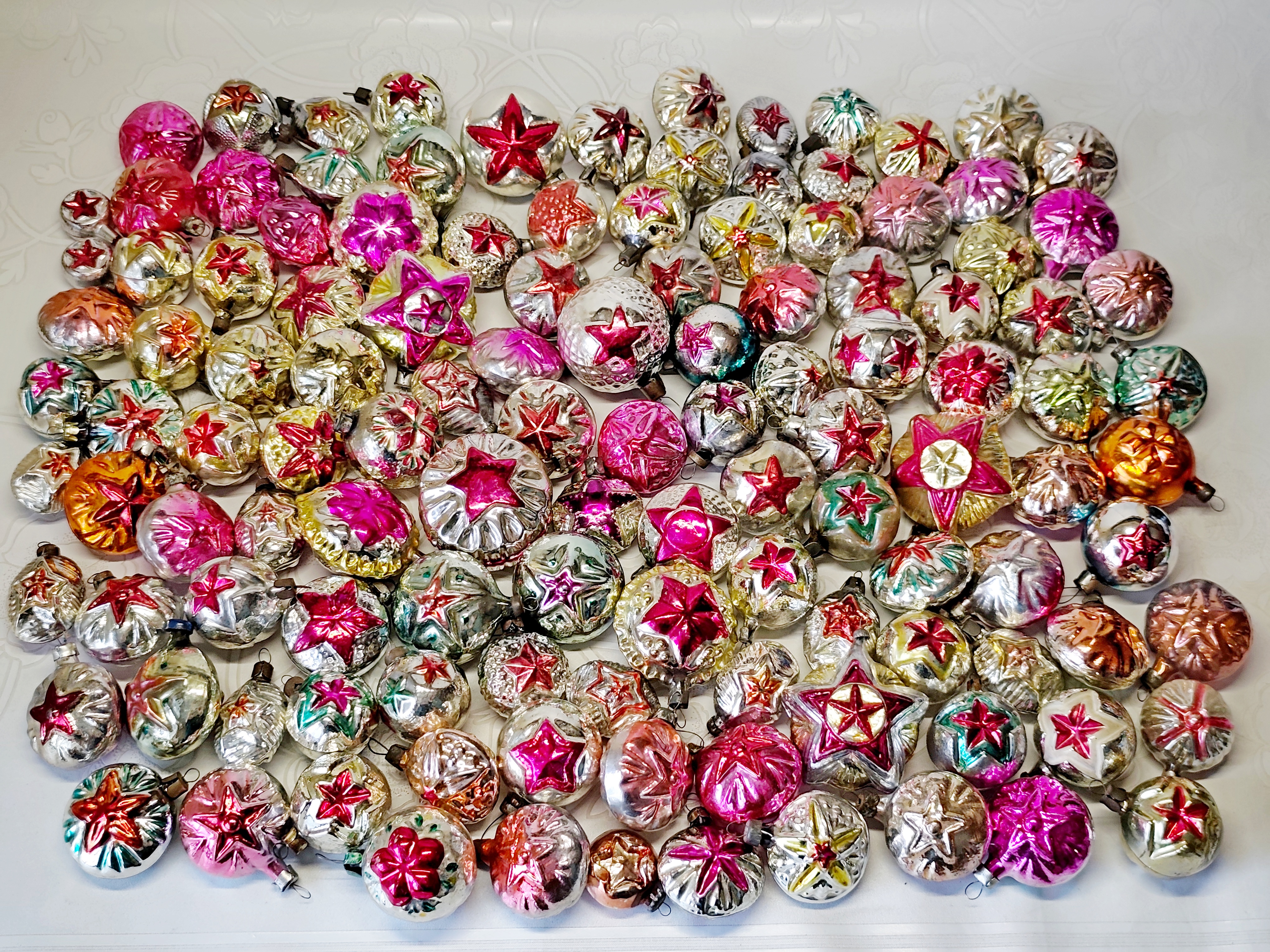
Soviet glass blowers displayed incredible craftsmanship in reimagining the star. Unlike mass-produced plastic versions of the late era, early and mid-century glass stars were often handmade, using thin glass and vibrant lacquers. Common forms include:
- Classic Spheres with Convex Stars: Round baubles where the star is embossed or "pushed out" from the glass.
- Flattened "Lanterns": Symmetrical spheres, flattened on the front and back, creating a unique canvas for the star.
- Figural Stars: Ornaments shaped entirely like a star, often featuring "rays" or geometric patterns.
Despite being a state symbol, high-quality glass ornaments with the star are surprisingly rare. Glass is inherently fragile, and many of these pieces did not survive decades of use or the eventual collapse of the USSR. Finding a well-preserved collection is a true challenge for any enthusiast.
A Curated Legacy: My Personal Collection
The photographs on this page showcase my personal collection of authentic Soviet star ornaments. You can see the incredible variety—from the deep "ruby" reds to the shimmering silver and gold amalgams. Each piece has been hand-selected for its historical significance and preservation of color.
As a collector, I believe these stars aren't just for the holidays—they are a way to touch history, preserved in the most delicate of materials.
How can we help?